Arabic has sounds English does not, so this journal spells Arabic words with a few extra marks: a line over long vowels, a dot under the emphatic consonants, and two small half-rings for ʿayn and hamza.
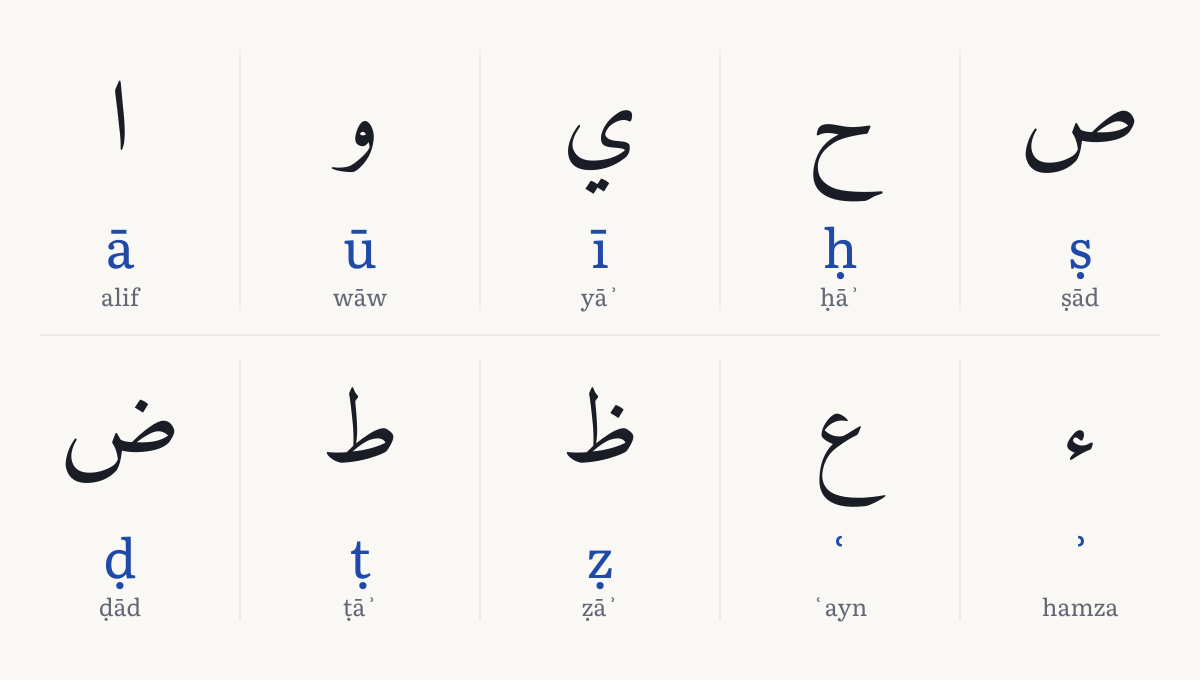
The two half-rings are easy to confuse. ʿ (opening) is ʿayn, a sound made deep in the throat, as in ʿilm, knowledge. ʾ (closing) is hamza, a glottal stop, as in Qurʾān.
Familiar words keep their familiar English spelling when they have one: Muhammad in running English, Mecca, Qur’an. Full transliteration is used where precision matters: in names of scholars, titles of books, and technical terms such as tawḥīd.